Classical Knife Cuts
Uniformity isn't just about aesthetics; it dictates even cooking times. This is Day 1 in any culinary school.
The Standard Dimensions
Every professional cook must internalize these exact dimensions. Memorize them. You will be tested on this in school and during your first stage.
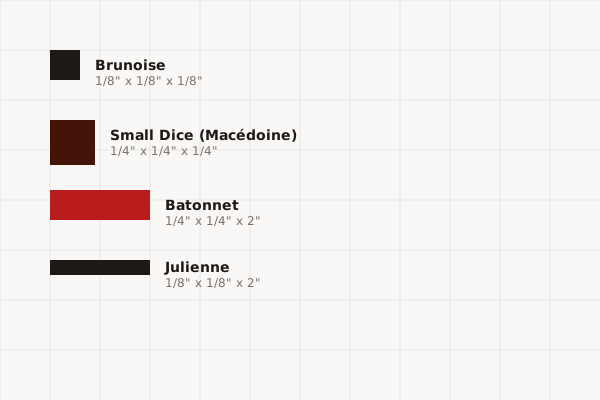
| Cut Name | Dimensions (Inches) | Common Usage |
|---|---|---|
| Fine Julienne | 1/16" x 1/16" x 2" | Garnishes, delicate raw vegetables. |
| Julienne (Allumette) | 1/8" x 1/8" x 2" | Stir-fries, salads, standard garnish. |
| Batonnet | 1/4" x 1/4" x 2" | French fries, crudité platters. |
| Fine Brunoise | 1/16" x 1/16" x 1/16" | Consommé garnish. (Cut from Fine Julienne). |
| Brunoise | 1/8" x 1/8" x 1/8" | Soups, stuffings. (Cut from Julienne). |
| Small Dice (Macédoine) | 1/4" x 1/4" x 1/4" | Soups, mirepoix. (Cut from Batonnet). |
| Medium Dice (Parmentier) | 1/2" x 1/2" x 1/2" | Stews, roasted root vegetables. |
| Large Dice (Carré) | 3/4" x 3/4" x 3/4" | Stocks, long-braising vegetables. |
Common Mistakes
- Not squaring off the vegetable: If you leave rounded edges, your dice will be uneven, and your yield will be inconsistent. This affects your food cost calculations.
- Dull Knives: Crushing herbs or bruising tomatoes instead of slicing them clean. Maintain your tools.
- Working messy: A disorganized cutting board leads to cross-contamination. Keep your prep list clear and work one item at a time.
Frequently Asked Questions
- What do I do with the trim?
- Never throw it away. The rounded pieces left over from squaring a carrot are used for mirepoix or to flavor stocks for mother sauces.
- How fast do I need to be?
- Accuracy comes first. Speed comes second. You cannot serve sloppy cuts in fine dining. Once you are accurate, you build speed to manage labor costs.
The Process: Squaring the Vegetable
To achieve these cuts, you must sacrifice yield for uniformity. This means "squaring off" round vegetables (like potatoes or carrots) by cutting off the rounded sides to create a perfect rectangular block.
- Peel the vegetable.
- Slice off a small portion of one side to create a flat, stable base.
- Rest the vegetable on the flat base and trim the remaining rounded sides.
- You now have a rectangular block. Slice this block lengthwise into slabs of your desired thickness (e.g., 1/4" for Batonnet).
- Stack the slabs and slice them into sticks (Batonnet).
- Line up the sticks and cut crosswise to create dice (Macédoine).
If you're unsure about scaling a large prep job for dice, use our Recipe Scaler.